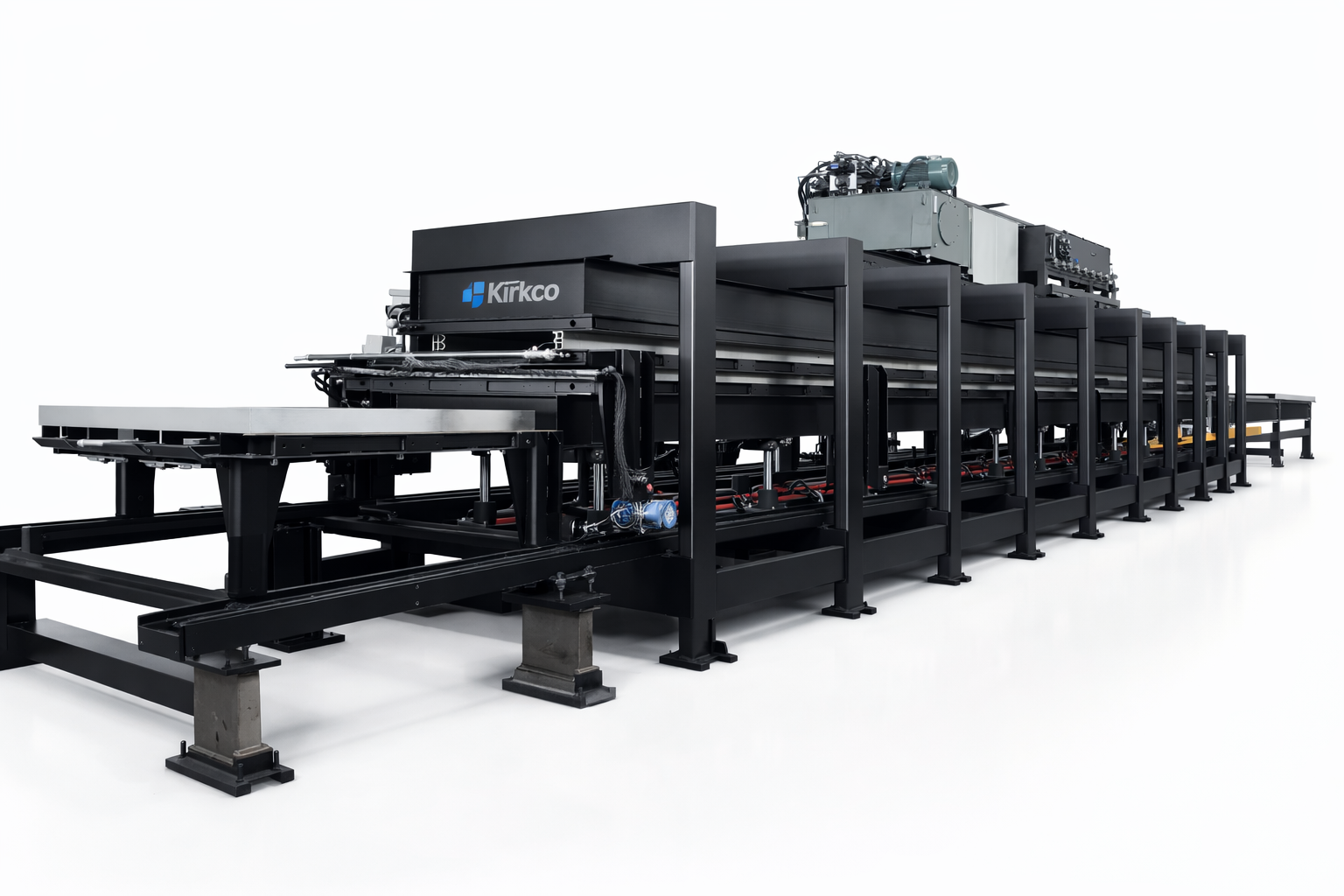
Sandwich Panel Manufacturing Solutions

Sandwich panels and structural composite panels are critical components in industries such as transportation, construction, aerospace, energy, and industrial equipment. These engineered panels combine multiple layers — often with core materials and skins bonded with adhesives — to achieve structural strength, lightweight performance, insulation, and durability.

At Kirkco, we provide precision dispensing, sealing, bonding, and automation systems that help manufacturers produce high-quality sandwich panels with consistent material application, tight tolerances, and optimized cycle times.

What Are Sandwich & Structural Panels?

Sandwich panels typically consist of:

  • Outer skins (metal, composite, or engineered surfaces)

  • Core material (foam, honeycomb, balsa wood, or composite core)

  • Adhesive or resin interface that bonds skins to core

The adhesive layer is critical — it must be applied accurately, evenly, and consistently to ensure maximum bonding strength and structural performance. Misplacement, inconsistent bead size, voids, or uneven wet-out of adhesives can compromise panel integrity and lead to defects.

Kirkco’s solutions are engineered for repeatable precision and reliability across a range of panel types and production volumes.

Kirkco Solutions for Sandwich Panel Processes

Precision Bead & Line Dispensing

Accurate adhesive line dispensing is essential for strong, uniform bonds in structural panels. Kirkco systems provide:

  • Controlled bead width and height

  • Closed-loop servo or proportional control

  • Wide bead capability for core bonding

  • Metered material delivery to prevent excess usage

These systems ensure accurate adhesive distribution over panel surfaces of any size.

Metering & Mixing for Reactive Adhesives

Reactive and filled adhesives require precise metering and mixing to achieve uniform cure and optimal bond strength. Our platforms include:

  • Volumetric gear pumps

  • Progressive cavity pumps

  • Plural component metering & mixing

  • Static and dynamic mixing heads

Combined with controlled dispensing, these systems deliver consistent chemistry and structural integrity.

Automation & Motion Integration

For panel assembly lines, Kirkco provides:

  • XYZ gantries

  • Multi-axis motion systems

  • PLC & HMI control

  • Integration with presses and conveyors

Automation reduces operator variability, improves cycle times, and ensures reproducibility at scale.

Application Architecture – Discontinuous PU / PIR Panel Production

Executive Overview

This Application Architecture defines discontinuous PU/PIR panel production systems designed for batch, press-based, or cell-based manufacturing environments. The architecture supports insulated panels, structural sandwich panels, and specialty panel formats where flexibility, controlled curing, and repeatable quality are required without continuous line infrastructure.

Business & Manufacturing Drivers

Manufacturers adopt discontinuous panel systems to support lower production volumes, higher product variability, or constrained facility layouts. Key drivers include reduced capital investment, rapid product changeover, precise thickness control, and the ability to manufacture multiple panel geometries on a single platform.

Material & Process Requirements

Two-component polyurethane or polyisocyanurate systems are metered at controlled ratios and temperatures to ensure uniform foam expansion and adhesion to facers. Processes must accommodate variable shot sizes, press cycle times, and mold or press configurations while maintaining density and bond integrity.

System Architecture

The system integrates bulk material storage, high- or low-pressure metering units, mixing heads, precision dispense into molds or press cavities, heated press stations, and controlled curing environments. Material delivery, press actuation, and cure timing are engineered as a coordinated system rather than isolated subsystems.

Controls & Automation

PLC-based controls manage metering output, shot timing, press sequencing, and temperature profiles. Recipe management enables rapid transitions between panel formats and thicknesses while preserving process stability.

Quality & Validation Framework

Validation procedures confirm panel density consistency, thickness tolerance, surface finish, and adhesion performance. The architecture supports repeatable FAT and SAT protocols aligned with building, insulation, and transportation standards.

Polyurethane Foam Systems Quality Framework Alignment

This application is governed by Kirkco’s Polyurethane Foam Systems Quality Framework, ensuring standardized process control, validation methodology, and lifecycle scalability across discontinuous panel systems.

Operational Scalability & Lifecycle

The architecture supports expansion through additional presses, parallel cells, or automation upgrades without redesign of the core metering and control platform.

NDA-Safe Application Context

This architecture reflects multiple discontinuous panel deployments across construction, cold-chain, and specialty manufacturing markets. Specific customer implementations are executed under NDA while maintaining a standardized engineering framework.

Confidential CTA

Kirkco provides discontinuous panel production architectures under NDA, supporting feasibility studies, pilot systems, and scalable production deployment.